What is BCAA?
The basis of all body tissues are proteins that are synthesized from amino acids. There are about 500 species of amino acids in nature, but only 20 are needed for the human body. Amino acids are substitutable (their human body can produce independently) and indispensable (they cannot be produced by the body, so they come from outside – from food or food additives).
QUERY LENGTH LIMIT EXCEEDED. MAX ALLOWED QUERY : 500 CHARS
The role of amino acids is crucial for:
- metabolism and energy metabolism;
- nervous system and mental health;
- support of brain function, memory, concentration;
- tissue regeneration;
- detoxification of the liver, restoration of its tissues after inflammation, prevention of fat deposits in the body;
- synthesis of growth hormone;
- muscle growth and development and joint support;
- healthy hair, skin and nails;
- support of the immune system.
Amino acids have antioxidant properties, slow down the aging process, maintain skin health, stimulate sexual desire and libido.
BCAA (branched-chain amino acids)is the most common sports amino acid, which includes essential amino acids valine, leucine and isoleucine. All three components are well combined with each other, complementary and reinforce each other's actions.
BCAA properties are used by professional athletes and bodybuilders to increase endurance and performance, increasing strength and building muscle volume.
The main functions of BCAAs are:
- improves endurance during training;
- regular intake improves aerobic and anaerobic performance;
- strengthens the immune system;
- prevents the development of muscle atrophy;
- improves muscle growth;
- reduces muscle pain and prevents muscle damage.

BCAA decoding (leucine, isoleucine, valine)
Three components of BCAA – leucine, isoleucine, valine perform their special functions as part of the complex.
| Amino acid | FUNCTIONS |
| Leucine |
|
| Isoleucine |
|
| Valine |
|
Leucine(C6H13NO2) is an essential amino acid from dehydrated lancet, which is a stimulator of anabolic processes in organisms, activates the mechanisms of protein synthesis and is an important factor for promoting the growth and renewal of meat fabrics.
Functions of leucine:
- stimulates protein synthesis;
- maintains a positive nitrogen balance and prevents the destruction of muscle tissue;
- reduces muscle fatigue;
- accelerates the recovery of muscle fibers;
- helps cells to absorb glucose faster, thus increasing energy reserves.
- stimulates tissue growth and repair.
Isoleucine(C6H13NO2) – an essential amino acid that provides physical and mental vitality and regulates process of energy supply to the body. Isoleucine is important for hemoglobin synthesis and blood level regulation glucose in the blood. Wine contributes to the functioning of the intestine, tissue regeneration, and the production of growth hormone.
Lack of isoleucine in the body causes a feeling of anxiety and anxiety, can cause overexcitation, dizziness, palpitations, drowsiness, general lethargy and lead to the development of hypoglycemia.
Functions of isoleucine:
- participates in the synthesis of proteins;
- maintains the required level of nitrogen;
- promotes rapid gain of muscle mass;
- improves endurance and increases the effectiveness of training;
- reduces the risk of injury and fatigue;
- helps to reduce fat mass without muscle loss;
- promotes rapid recovery from physical exertion.
Valine(C5H11NO2) is an essential amino acid that is the main participant in the process of tissue growth and renewal. Take part in the synthesis of vitamin B5 (pantothenic acid), which helps relieve stress and chronic depression This changes the production of cortisol. It has a positive impact on the psycho-emotional state and the functioning of the brain.
Valine is a powerful source of energy in muscle tissues and membranes, which affects the intensity and speed ofmuscle contractions and allows for better coordination of movements. Has the ability to reduce the sensitivity of the body to fluctuations temperatures and raise the pain threshold.
Valine Functions:
- accelerates protein synthesis and promotes accelerated tissue regeneration;
- supports the exchange of nitrogen in the body;
- is a source of energy for muscle tissues;
- improves metabolism;
- maintains normal serotonin levels;
- stabilizes the hormonal background.
The role of amino acids in the structure of protein
QUERY LENGTH LIMIT EXCEEDED. MAX ALLOWED QUERY : 500 CHARS
QUERY LENGTH LIMIT EXCEEDED. MAX ALLOWED QUERY : 500 CHARS
When the polypeptide chain is ready, the termination step occurs. It is signaled by a triplet of nucleotide residues in the mRNA, which is called a stop codon. The function of stop codons in protein synthesis is to report the completion of the assembly of a polypeptide chain.
Protein synthesis in cells occurs in the interphase – the period between division. Protein molecules are synthesized in the cell for 1-2 seconds.
So, for protein synthesis it is necessary to:
- energy in the form of adenosine triphosphate (ATP);
- enzymes;
- information about the structure of the protein;
- amino acids and their corresponding RNA transports;
- ribosomes.
Why BCAAs are needed

QUERY LENGTH LIMIT EXCEEDED. MAX ALLOWED QUERY : 500 CHARS
Since BCAAs are involved in the formation of muscle protein, they will be necessary for anyone who has an increased need for protein. BCAAs entering the body, after absorption in the digestive tract are not processed in the liver, but enter directly into the muscles, where they are used as an energy source.
Protein synthesis and muscle growth
QUERY LENGTH LIMIT EXCEEDED. MAX ALLOWED QUERY : 500 CHARS
Reduced muscle breakdown
QUERY LENGTH LIMIT EXCEEDED. MAX ALLOWED QUERY : 500 CHARS
Catabolism can also cause starvation or irregular eating. To prevent catabolism, it is necessary to provide muscle with carbohydrates and amino acids, and BCAAs are the best solution in this situation.
Increased endurance
BCAAs are important for energy exchange. Products of acid metabolism are used for the synthesis of ATP – organic compound, which is the main fuel for muscles. Taking BCAAs before a workout provides extra energy for endurance and increases the effectiveness of training.
This effect of the use of BCAA amino acids is indispensable in a low-carbohydrate diet, when the body needs additional energy to support their activities.
Muscle recovery after training
QUERY LENGTH LIMIT EXCEEDED. MAX ALLOWED QUERY : 500 CHARS
Maintaining muscle mass while losing weight
The benefit of BCAAs in weight loss is that their intake contributes to the normalization of metabolism, the violation of which is one of the the main reasons for weight gain. Leucine and isoleucine regulate the metabolism of fats and stimulate the breakdown of fat deposits. Valine suppresses appetite, which is also an important factor for weight loss.
Athletes use BCAAs both to gain muscle mass and to lose weight – they activate metabolic processes, under during which extra calories are burned, without reducing muscle mass.
If there is a need to lose weight using BCAAs, two points should be taken into account:
- BCAAs should not be used as a substitute for a healthy diet – only as an addition to the main diet.
- You can lose weight only by combining supplements, healthy eating and exercise.
What BCAAs can be combined with

BCAAs can be combined with other types of sports nutrition and vitamin-mineral complexes – in this combination their action will be more effective.
Protein.The combination of BCAAs with whey or vegetable protein enhances muscle protein synthesis, providing the body with the necessary amino acids.
Creatine, arginine, pre-workout complexes.In combination with BCAAs, they increase endurance during power loads and improve athletic performance. An additional amount of amino acids will add the required energy, BCAA will support anabolic processes and prevent premature fatigue.
Vitamins and minerals.It will be useful to combine BCAAs with B vitamins, magnesium and zinc. They support metabolism and energy metabolism.
Hydration additives (isotonics).During prolonged physical exertion, BCAAs can be combined with electrolytes to prevent dehydration.
Energy drinks.BCAAs can be added to energy drinks containing caffeine to improve energy and concentration during training.
How to take BCAAs correctly

The mode of admission depends on your goals, lifestyle and individual characteristics.
How many times a day should I drink BCAAs?
On the day of training, it is correct to take amino acids in the morning before breakfast to reduce catabolism, before training, if you do not have time to eat, and after its completion to restore muscle fibers. Some experts recommend taking another dose of BCAAs during exercise if it lasts more than one hour and there is a need for extra energy. To reduce fat mass, it is recommended to drink BCAAs additionally between meals to reduce appetite and preventing catabolism.
One serving of amino acids in powder form is 5 grams. Recommended daily intake said on the package of a particular manufacturer.
How much to take WCAA?
The duration of use of BCAAs is not limited, they can be drunk on an ongoing basis, no side effects are observed.
What is the maximum dosage of BCAAs?
Professionals recommend taking no more than 8 g of amino acids in 1 dose. But it's always worth remembering individual needs of the body and consult a doctor or dietitian before starting new supplements.
In what form are BCAAs produced?
BCAA amino acids are released in powder, tablet, capsule, and liquid form.
Powder– the most popular form of BCAA among athletes. The powder has a pleasant taste, it is easy to to make cocktails.
TabletBCAAs are easy to use because they don't take up much space and can be carried around. Their composition does not includes flavors, sweeteners, and other additives.
Capsuleseasy to use, but absorbed a little longer than other forms of BCAAs.
Liquid.Liquid amino acids are typically released as a concentrate that must be diluted with water or in the form of ready-made shots. They are quickly absorbed, have a pleasant taste.
Remember that sports nutrition should not replace regular meals, but is only an addition to a balanced diet.
Excessive consumption of BCAAs can lead to an imbalance of amino acids in the body, which can cause disruption of the overall metabolism, as well as have a negative effect on the liver and kidneys. BCAA harm to men when consumed excessively high doses may be manifested by decreased testosterone levels and hormonal changes. Therefore, before you start take BCAAs, a doctor or dietitian should be consulted to assess the potential risks, harms, and benefits.
BCAA powder
The powder form of BCAA is the most common - it is rapidly absorbed in the gastrointestinal tract and increases concentration amino acids in the blood. The peculiarity of amino acids in powder is their insolubility in water: BCAA molecules have hydrophobic structure, that is, they repel the liquid. A shaker is required to properly mix BCAAs with water, juice, or other beverage.
The BCAA amino acid complex from TM Vansiton contains L-leucine, L-valine and L-isoleucine in a ratio of 2:1:1, as well as L-glutamine and Vitamin B6.
L-leucine is involved in the anabolic processes of muscles, in the synthesis of new protein structures.
L-isoleucine activates the synthesis of muscle protein by the mechanism of mTOR ("rapamycin target in cells").
L-valine is necessary for muscle metabolism, repair of damaged tissues and maintenance of normal nitrogen metabolism in organism.
L-glutamine is an amino acid involved in the growth of muscle cells, accelerates recovery after training, has anti-catabolic effect, is an energy source.
Vitamin B6 (pyridoxine hydrochloride) plays an important role in metabolism, participates in the functioning of the central and the peripheral nervous system and in the synthesis of neurotransmitters.
The amino acid complex supports high performance and endurance during heavy physical exertion, during prolonged workouts, adds energy, promotes muscle recovery after physical exertion.
How to use:
Mix one serving of 5 grams (2 measuring spoons) with 400 ml of water, drink 30-40 minutes before the start of training (physical loads) and immediately after their completion. Drink with water or non-acidic juice.
Do not use the product before going to bed. With large overdoses of 2-3 or more times, the effect of a strong excitation.
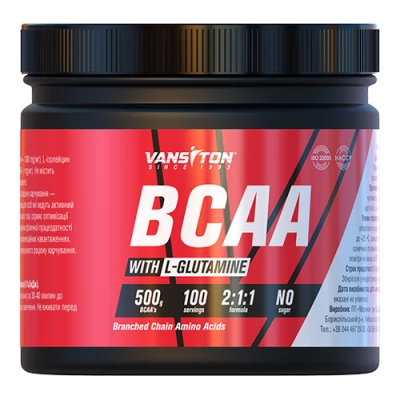
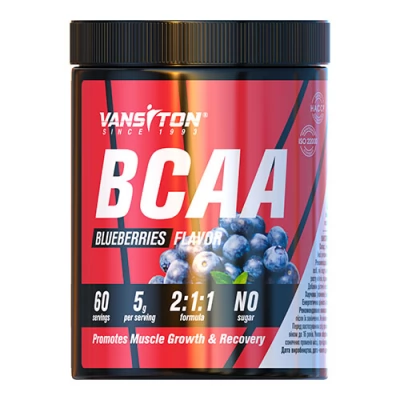
The BCAA amino acid complex with the blueberry flavor of TM Vansiton consists of amino acids in a ratio of 2:1:1 L-leucine, L-valine, L-isoleucine supplemented with vitamin B6.
The amino acid complex is rapidly absorbed, increases the level of amino acids in the blood, supports the growth of muscle tissues, adds energy, maintains high performance and endurance during long workouts. After training and physical exertion contributes to the rapid recovery of muscles.
How to use:
Mix one serving of 5 g (2 scoops) with 400 ml of water, drink 30-40 minutes before training, during training and immediately after it ends.
in capsules
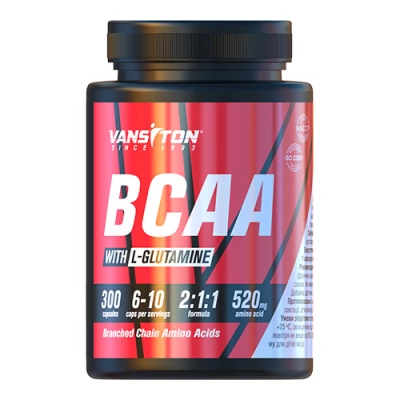
BCAA capsules contain L-leucine, L-valine and L-isoleucine in a ratio of 2:1:1, as well as L-glutamine and Vitamin B6.
The amino acid complex supports high performance and endurance during long workouts, adds energy, promotes rapid muscle recovery after training and physical exertion.
How to use:
6–10 capsules 30–40 minutes before the start of training (physical activity) and immediately after their completion. Wash down water or non-acidic juice. Do not use before bedtime. Do not exceed the recommended daily dose.
BCAA shot
Drinking shots can quickly increase the concentration of amino acids in the blood and accelerate protein metabolism.
The BCAA 2:1:1 drink shot box amino acid complex from TM Vansiton contains L-leucine, L-valine and L-isoleucine in ratio of 2:1:1. A balanced composition of drinking shots helps the body maintain the right level of energy, increases physical endurance and performance during exercise, promotes muscle recovery and growth, and after training speeds up recovery.
How to use:
One serving of 80 ml 30 minutes before the workout, and one serving immediately after the end of the workout. Do not exceed recommended daily dose. Do not use before bedtime.