What are resistance bands?
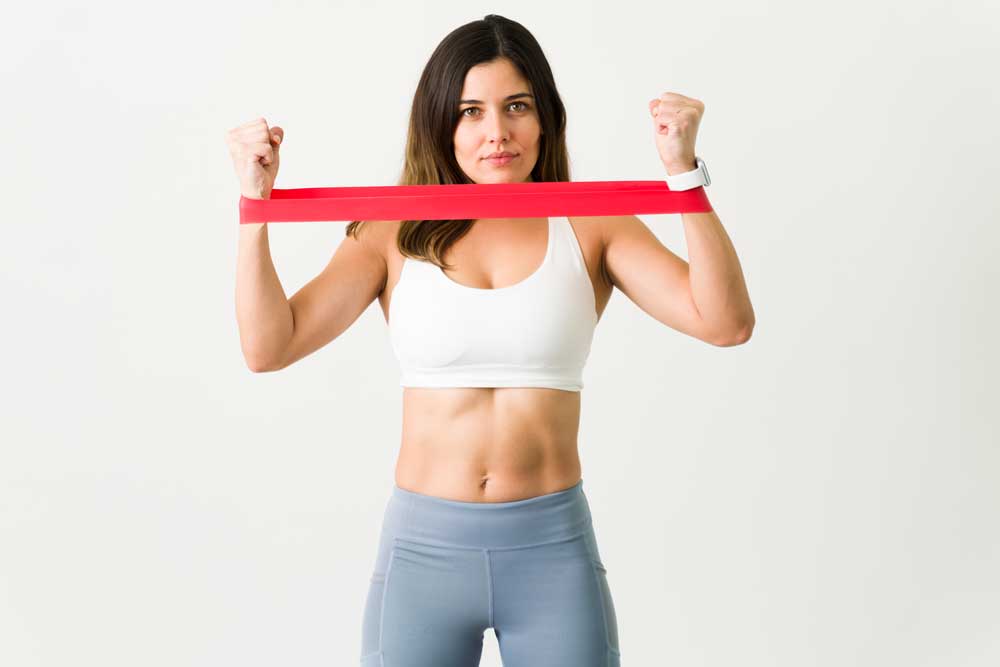
Fitness bands are a simple and popular piece of exercise equipment that allows you to stay in shape under any circumstances, especially if you don’t have time for sports or going to the gym.
This piece of exercise equipment goes by various names—resistance band, fitness band, mini band, rubber band, resistance ring, and resistance band.
Fitness bands work on the same principle as resistance bands: when stretched, they create resistance, and overcoming this resistance provides a workout for various muscle groups and helps train them.
Using fitness bands allows you to target and develop muscle groups that are rarely engaged during a typical workout. The even and distributed resistance helps build arm muscles, strengthen the abs, and improve the shape of the legs, glutes, and thighs. Exercises with fitness bands help sculpt the body, burn excess calories, improve posture, and achieve a slim, toned figure.
The Popularity of Resistance Bands in Modern Fitness
Resistance bands were used in physical therapy for the elderly and for the rehabilitation of athletes after injuries as far back as the 19th century.
The rapid rise in popularity of resistance bands began with Thera-Aerobics (Thera-Robics)—a set of exercises developed for health purposes by German trainer Y. Weissharz and Swiss physical therapist K. Schmidt in 1995. In their exercises, they used a latex “thera” band, which was secured to the limbs and offered varying levels of resistance. Exercises with the latex band accelerated fat burning in the body and promoted weight loss, strengthened muscles, and improved the functioning of the cardiovascular and respiratory systems.
This form of wellness fitness, which includes strength training, dance exercises, and stretching, has become very popular in fitness clubs across Europe and the United States in recent decades. Low-impact, high-intensity cardio workouts using a special set of elastic bands increase the intensity of the sessions, improve muscle development without adding bulk, reduce body fat, and sculpt a lean physique without excessive strength training.
The popularity of these workouts is also due to the fact that the simple exercises do not involve complex coordination movements and are accessible to everyone regardless of age, gender, or physical condition. An individualized approach to selecting a band with the appropriate resistance allows you to adjust the intensity and strength of the workout, while active movements set to music and choreographed elements create a pleasant emotional atmosphere and help maintain the desire to exercise.
Types of Fitness Bands
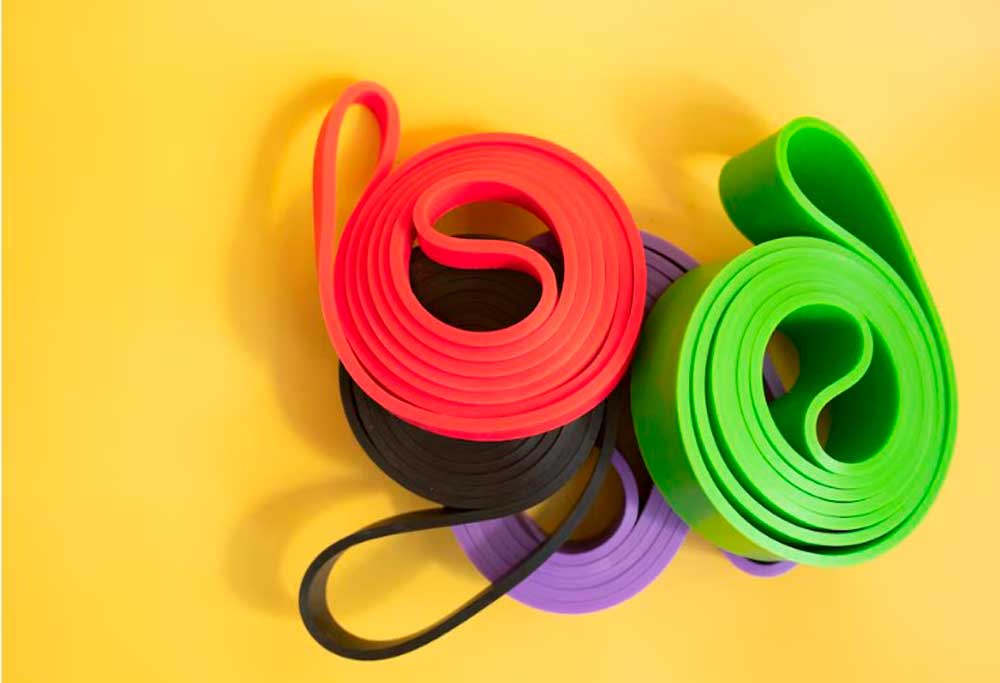
A fitness band is an elastic strap made of latex, polyurethane, rubber, or elastic fabric in the form of a loop or strip. Typically, the band is 5–7 cm wide and 30–60 cm long.
Types of resistance bands by material:
latex – durable, the most elastic and stretchy, resistant to deformation, retain their shape for a long time, and are relatively inexpensive. They are best suited for stretching exercises and cardio workouts.
fabric – have a soft surface that doesn’t dig into the skin, doesn’t twist, and doesn’t slip during workouts. The durable fabric prevents tears, so fabric models hold up well and aren’t damaged by frequent use. Fabric resistance bands are ideal for exercises that strengthen the thigh and gluteal muscles, as well as exercises with a wide range of motion, such as lunges or deep squats.
Rubber or silicone – stiff, not very stretchy, requiring significant effort to stretch.
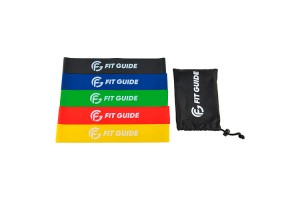
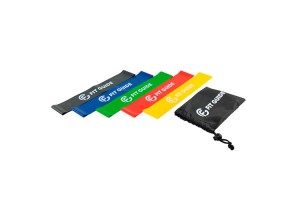
These bands are often sold in sets of five. They come in different colors, which indicate the level of resistance (or stiffness), and have letter codes depending on the manufacturer.
The general rule is: the darker the color of the band, the higher the resistance, and the more effort is required to work with it. Yellow, orange, or pink colors represent the easiest level; blue or purple represent the medium level; and black fitness bands are designed for professionals.
A set of latex fitness bands may include the following:
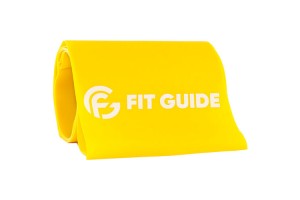
- Yellow band—beginner level (X-Light), for warm-ups, arm and shoulder exercises, and post-injury rehabilitation;
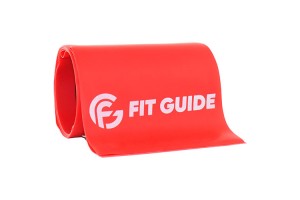
- Red band—light (Light), for warm-ups and to intensify simple exercises with low resistance;
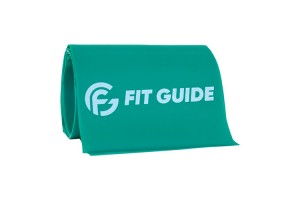
- Green band – medium level (Medium), increased resistance, for glute and thigh exercises;
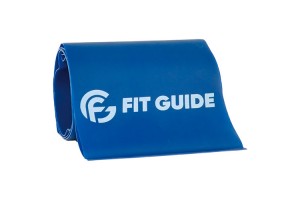
- Blue band – heavy level (Heavy) – intense resistance, for athletes with intermediate or advanced fitness levels;
- Black (X-Heavy) – high resistance level for professional use.
Each resistance band has its own approximate resistance level, which is measured in kilograms:
- X-Light – 1–3.5 kg
- Light – 2–5 kg
- Medium – 6–9 kg
- Heavy – 10–14 kg
- X-Heavy – 15–20 kg
Fabric resistance bands have their own specific parameters and resistance levels, so you should check the markings on individual models.
Fitness bands come in different thicknesses—the higher the resistance level, the harder the band is to stretch:
- X-Light – 0.35 mm
- Light – 0.5 mm
- Medium – 0.7 mm
- Heavy – 0.9 mm
- X-Heavy – 1.1 mm
How do you choose the right resistance band?
Fabric resistance bands are better suited for strength training: they provide stable and consistent resistance, which is important for exercises that require physical effort and precision. If your goal is to improve your cardio or speed, latex resistance bands are the best option, as they offer greater elasticity and are suitable for fast, dynamic exercises. Which fitness band to choose depends on your preferences, fitness level, and frequency of use, as well as whether you have a latex allergy.
How do you choose which fitness band to start with?
Experts recommend performing 12–15 repetitions of a single exercise for any muscle group using any band from the set. If you feel a sharp pain in your muscles after 12 repetitions, switch to a lighter band. If you can comfortably perform 12–15 reps or more, you can move on to a higher resistance level.
Benefits of Fitness Bands
The greatest benefit of fitness bands is that they distribute the load evenly across the muscles without straining the joints or spine. This allows people who have problems with their joints, ligaments, knees, or spine—or who are recovering from injuries—to exercise fully.
Benefits of fitness bands:
Versatility – suitable for men, women, children, and seniors, regardless of fitness level or physical condition.
Variety of exercises – you can mix up or supplement your usual strength training with resistance band exercises. Whether it’s a warm-up before a run or before your main workout, all your muscles will be engaged and warmed up.
Effectiveness – training with a fitness band is just as effective as training with strength machines and free weights. Using a fitness band allows you to work all muscle groups—arms, shoulders, abs, back, hips, legs, and glutes—and see results after just the first few sessions.
Convenience and Compactness – A set of resistance bands is compact in size and is often sold in a special carrying case, which is convenient to take with you when traveling or on vacation.
Fat-burning effect – Working out with resistance bands relies exclusively on your own body weight and is a great option for those looking to lose weight.
Affordability – A wide selection and affordable prices make fitness bands a more cost-effective option than a gym membership or a home exercise bike.
Safety – Effective exercises with resistance bands can be performed by older adults, those undergoing rehabilitation after injuries, and people with joint problems—the bands do not put pressure on or injure joints, and therefore keep joints and ligaments safe.
Ease of Use – You can train with resistance bands regardless of your fitness level—or even without any prior experience. You can set up a resistance band workout at home at any convenient time, even if you’ve never exercised before.
Basic Exercises with Fitness Bands
How do you work out and use a fitness band for exercises? Simply place it around the part of your body whose muscles you plan to train. Perform the exercises at a slow pace, doing 10–15 repetitions per set for 3–4 sets, with a rest of up to 60 seconds between exercises.
Exercises for the arms, shoulders, and chest
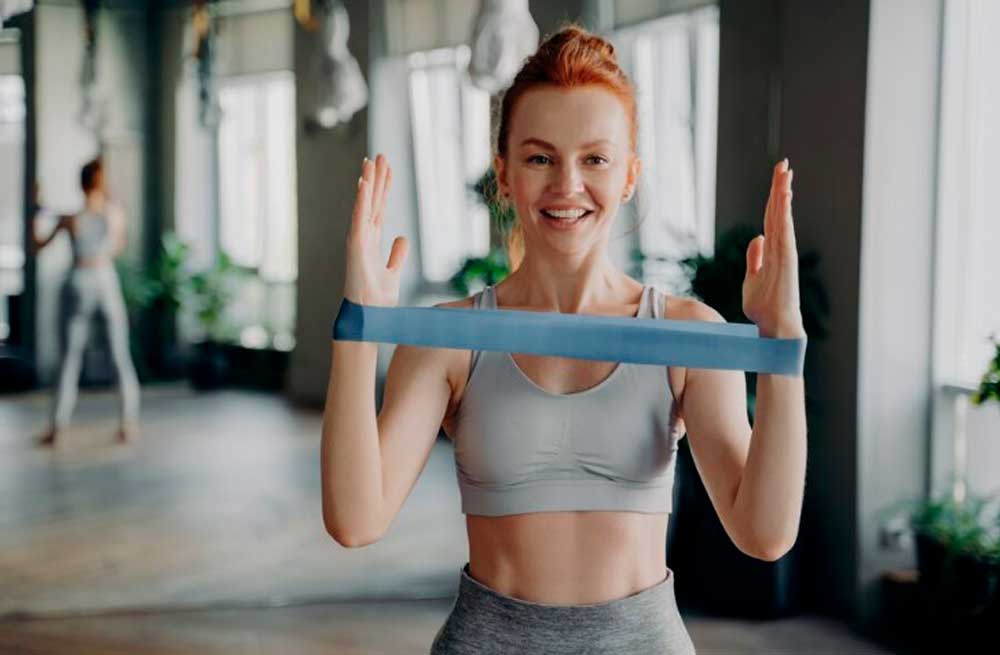
Arm abduction with a resistance band. Stand up straight with your feet shoulder-width apart. Stretch the resistance band between your palms. Spread your arms out to the sides as wide as possible, then bring them back together.
Overhead press. Place the resistance band around your wrists. Stand up straight and raise your arms overhead. Bend your elbows and gradually spread your arms out to the sides so that your shoulder blades come together. Return to the starting position.
Arm Curl with a Resistance Band. Kneel on your left knee and place your right leg, bent at the knee, in front of you. Place the resistance band under the knee of your right leg and hold the other end in your right hand. Bend your arm and pull the band toward your back. This exercise strengthens both your back and arm muscles.
Exercise for a firm bust. Place the resistance band around your forearm and bend your arms at the elbows. Slowly spread your arms out to the sides as far as possible.
Standing oblique twists. Stretch the resistance band under your feet between your legs. Stand up straight with your feet shoulder-width apart and your hands behind your head. Bend your left arm at the elbow and pull your right leg toward your chest, then repeat the same motion with the other leg and arm.
Exercise with arms extended. Place the resistance band on your palms. Lie on your stomach with your feet on your toes. Extend your arms forward so they form a straight line with your body. In one smooth motion, pull your arms toward your hips, bringing your shoulder blades together. Pause for 1–2 seconds when you feel resistance. While performing the exercise, your elbows, forearms, and arms should remain above the line of your hips.
Ab and Back Exercises
The “Scissors” Exercise. Place the resistance band around your ankles. Lie on the floor with your arms at your sides, palms down. Raise your legs to a 30-degree angle, keeping your lower back on the floor. Move your legs up and down alternately. Do not let your legs touch the floor during the exercise.
Leg Curls. Place the resistance band around your ankles. Lie on your stomach with your hands under your head. Stand on your toes, then lift your right leg, followed by your left, bending at the knees.
One-arm pull. Place the resistance band under your foot and hold the other end in your hand. Pull the band up toward your pelvis with your hand, squeezing your shoulder blades together and keeping your back straight. Then do the same with the other hand.
Exercises for the Legs and Glutes
Squats and lunges are the best exercises for the inner thighs, glutes, and legs. These exercises engage a large number of major and minor muscles. In addition, these exercises promote weight loss.
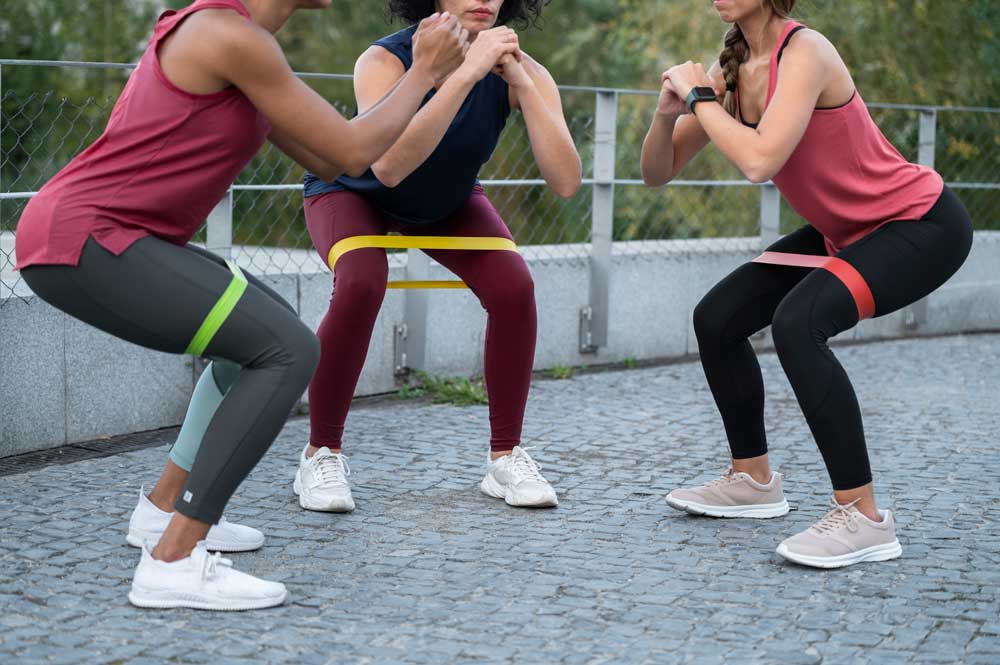
Squats with a resistance band. Place the resistance band around your hips. Stand up straight with your feet shoulder-width apart and your hands clenched into fists in front of you. Slowly lower yourself until your knees are bent at approximately a 90-degree angle. From the bottom position, rise one-quarter of the way up, then lower yourself again before standing up straight. Return to the starting position.
Lunges with a fitness band. Place the band 5–7 cm above your knees. From a standing position, with your hands clasped in front of you, step forward so that your leg forms a right angle and your knee does not extend past your toes. The leg remaining behind should not fully touch the floor. Return to the starting position. Repeat with the other leg.
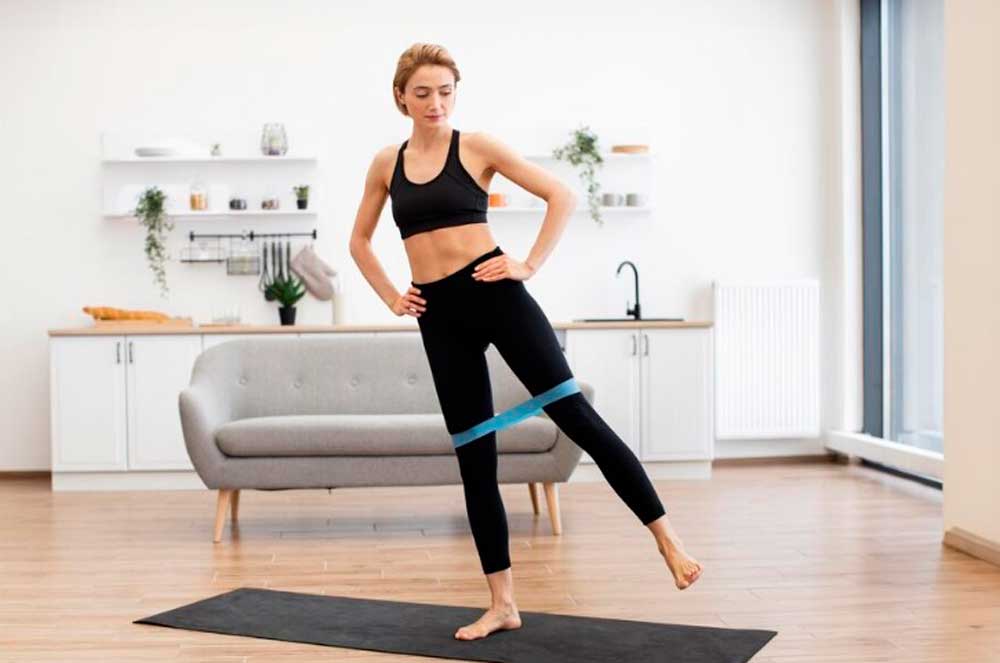
Side steps with a floor touch. Stand up straight with your hands on your hips and your feet shoulder-width apart. Place the resistance band above your ankles. Step one leg out to the side as far as possible, lower your body, and touch the floor with your hand. Return your leg to the starting position. Repeat the same movement with the other leg to the opposite side.
Thigh exercise. Place the resistance band around your ankles. Stand up straight; use a chair for support if necessary. Extend your straight leg backward about 30 degrees. Then repeat with the other leg.
“Anti-cellulite” resistance band exercise. Lie on your back, supporting yourself on your straight arms. Place the resistance band 20 cm above your knees. Bend your knees and slowly spread your legs apart.
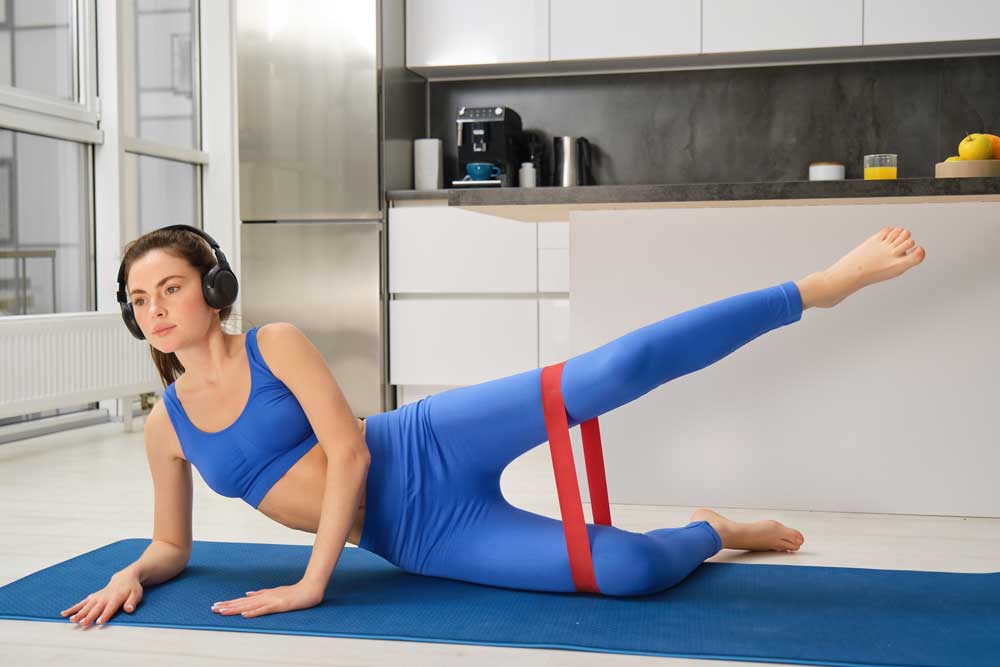
Leg swings. Place the resistance band above your ankles. Lie on your side, resting on your elbow. Slowly lift and lower your top leg, then roll onto the other side and repeat the same movements with the other leg.
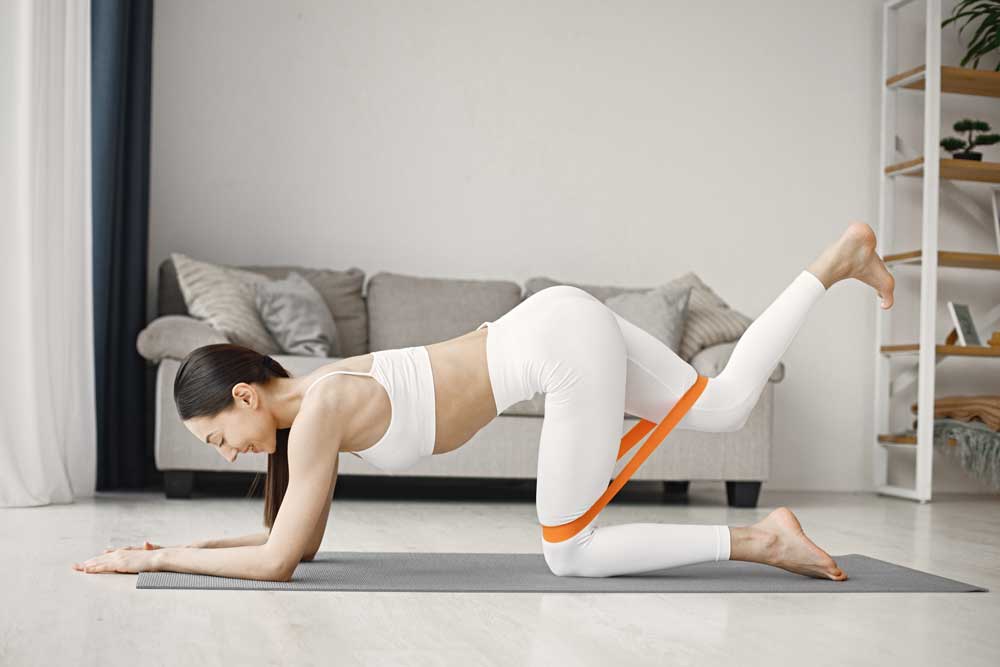
Leg lifts. Place the resistance band just above your knees. Get on your knees on the floor, resting on your elbow. Alternately lift your legs upward, keeping your back straight.
Bridge exercise. Place the resistance band above your knees. Lie on your back with your knees bent and your feet flat on the floor. Lift your hips and spread your knees apart, then return to the starting position.
Tips for Using Resistance Bands
You can perform a wide variety of full-body exercises using resistance bands.
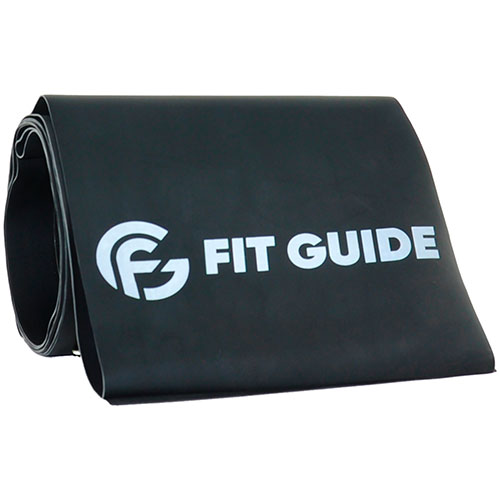
A single Fit Guide set, which includes 5 bands of varying resistance levels, serves as a versatile fitness tool for maintaining physical fitness, improving muscle definition, strengthening muscles, losing weight, or achieving any other fitness goal you set for yourself. The set is suitable for both beginners and experienced athletes. Using fitness bands will allow you to expand the range of your workouts by targeting different muscle groups, including your legs, arms, back, chest, and glutes. Using the bands helps improve flexibility and range of motion, which can reduce the risk of injury and improve athletic performance.
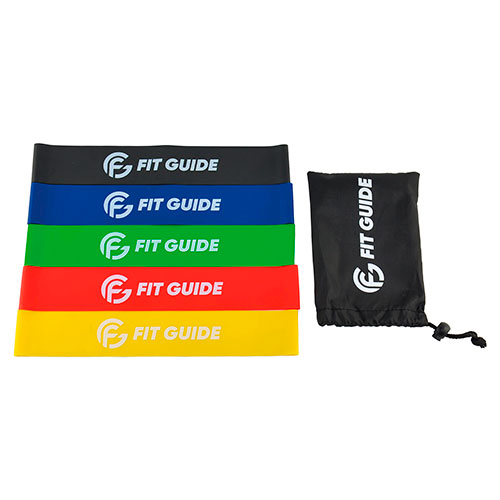
The Fit Guide resistance band, also known as an expander, is a versatile fitness and training tool that helps improve physical fitness, strengthen muscles, and stretch the body.
Thanks to its elasticity, the band can provide varying levels of resistance during exercises, allowing you to tailor the intensity to your needs and physical capabilities. The band can be used for a variety of workouts, such as stretching, muscle strengthening, posture correction, flexibility exercises, and rehabilitation exercises.
This fitness accessory can be useful for both beginners and experienced athletes, as it allows you to gradually increase the intensity of your workouts depending on your current needs.
Proper Exercise Technique
Proper exercise technique is, first and foremost, maintaining the correct body position to prevent potential injuries and optimize the effectiveness of your workouts.
Proper exercise technique involves:
Maintaining proper posture. The neck, back, or other parts of the body not involved in the exercise should not be tense.
Body stability. When performing exercises, avoid excessive movement and too wide a range of motion.
Controlling speed. Perform the exercises at a controlled, slow pace, without sudden or uncoordinated movements.
Maintaining tension in the resistance band. The resistance band must not be slack while performing the exercise—this directly affects the effectiveness of your workouts.
Warm-up and stretching. Exercises to warm up your muscles and prepare for physical activity, as well as exercises to relax your muscles after a workout, are equally important. This helps prevent overexertion and injuries and reduces the risk of injury.
Workout Intensity and Frequency
To achieve noticeable results, you need to work out at least three times a week for 40–60 minutes. This is the ideal frequency to see progress while allowing your muscles time to recover.
If you’re short on time, structure your workouts so that you target one muscle group per session—for example, arms and shoulders in one session, back in another, and legs and glutes in the third.
Combining Resistance Bands with Other Equipment and Bodyweight Exercises
Within a single workout, you can combine exercises using resistance bands with other equipment. For example, start with a warm-up to loosen up your joints and ligaments, then move on to strength exercises using exercise equipment. If you’re working out at home, resistance bands are a great way to target specific muscles after your main bodyweight exercises.
Increasing the Load
For beginners, we recommend starting your workout with a resistance band at the lowest resistance level and gradually increasing the load. Movements should be smooth, slow, and relaxed.
Common Mistakes and How to Avoid Them
Incorrect exercise form can lead to improper load distribution and, in the worst case, to injuries.
Incorrect exercise technique
Incorrect technique when performing exercises with resistance bands can lead to injuries and reduce the effectiveness of your workout. Pulling the resistance band too tightly or choosing the wrong resistance level can lead to muscle strain and imbalance. Always start your workouts at a lighter resistance level and gradually increase the load to avoid injury. Perform the exercises smoothly and mindfully, without any sudden movements. Pay attention to your posture, breathing, and how your body feels. Your body will let you know if something isn’t right.
Muscle Overload
To avoid muscle overload, perform exercises at a slow pace. If you experience discomfort or pain, reduce the intensity or shorten your workout routine.
Failure to warm up and stretch
Warming up is essential! It warms up “cold” muscles, increases the elasticity of muscles, ligaments, and tendons, and consequently reduces the risk of injury. A warm-up “triggers” a gradual increase in the rate of the cardiovascular and respiratory systems, accelerates blood circulation and metabolism, and oxygenates the body, which boosts endurance. A 5–15-minute warm-up is sufficient.
Stretching exercises increase the flexibility of muscles and joints, and after a workout, they help relax the muscles for full recovery.
Are resistance bands suitable for beginners?
Yes, resistance bands can be used for workouts by both beginners and experienced athletes.
Which resistance bands should I choose for home workouts?
For home workouts, you can choose latex or fabric resistance bands depending on your preferences. For beginners, it’s best to purchase a set of 5 resistance bands with different resistance levels.
How many times a week can you train with resistance bands?
To achieve visible results, you should train with resistance bands regularly, at least 3–4 times a week.
Can you combine resistance bands with other types of workouts?
Yes. Resistance bands can be combined with all types of workouts.